Local GuidesWater Heaters
Tankless vs Tank Water Heater in Houston
A tankless water heater heats water on demand; a tank water heater keeps a tank of water hot around the clock. Tankless vs tank water heater in Houston, compared on install, monthly operating costs, lifespan, and which system fits your home.
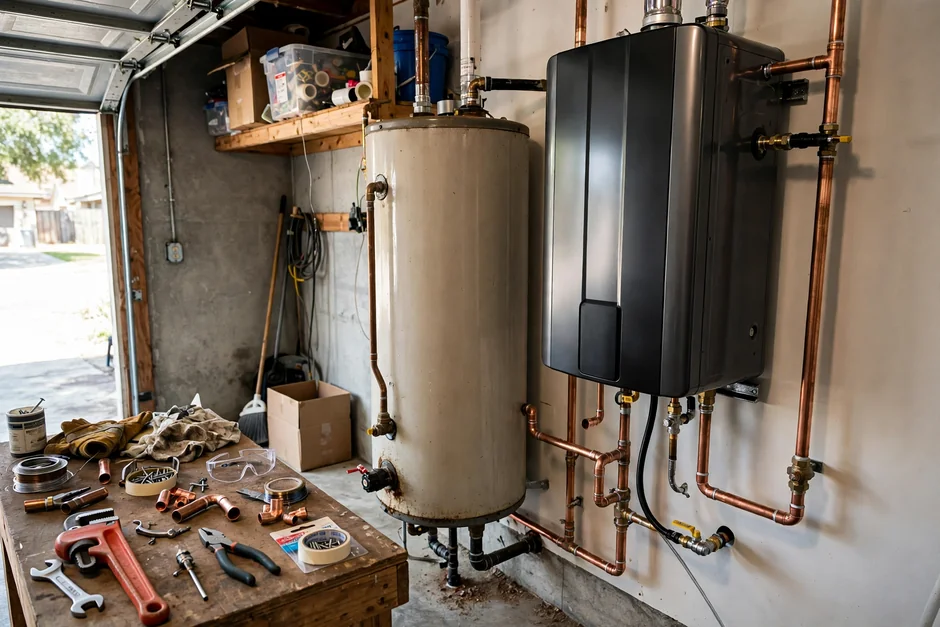
A tank water heater and a tankless unit solve the same problem in very different ways. Tankless costs more up front, but it generally lasts longer when maintained and only heats water when a tap opens. The rest of this post compares the two systems line by line, explains why Houston's water and climate change the math, and helps you decide which system actually makes sense for your house.
The Short Answer on Tankless vs Tank in Houston
Tankless vs tank water heater cost in Houston comes down to two things: what you pay on install day and what you pay every month after. A standard 50-gallon tank unit is cheaper to buy and cheaper to install because it drops into the same spot, same venting, same gas line as the old one. A tankless unit costs more because it needs a bigger gas line, stainless venting, and sometimes an electrical run for the igniter.
Here is the honest split:
- Tank: cheaper to buy and install, generally lasts a shorter time, keeps water hot all day whether anyone is home or not.
- Tankless: costs more up front, generally lasts longer when maintained, heats water only when a tap opens.
If you plan to stay in your home more than seven years, tankless usually wins on total cost over the long term. If you are selling next year or watching every dollar today, a tank replacement is the smarter move. We install both, and we will tell you straight which one fits your situation.
What Drives Water Heater Install Cost in Houston, Texas
Water heater prices Houston Texas homeowners see on a quote are built from five moving parts, and every one of them can change the total.
1. The unit itself
A 40-gallon gas tank is the smaller standard size. A 50-gallon is the common family size. A residential tankless unit is sized by flow rate - you need about 7.5 gallons per minute to run two showers and a dishwasher at once.
2. Venting and gas line work
Tank units vent through a metal flue that usually already exists. Tankless units need stainless steel venting and often a 3/4-inch gas line upgrade because the burner pulls far more BTU at once.
3. Location and code
Houston homes built before 1990 often have the water heater in a closet or attic. Moving a unit, adding a drain pan, or bringing the T&P relief line up to current code adds to the job. Attic installs in this humidity also push us toward tankless more often than not - a tank in a 140°F attic dies young.
4. Water quality
Houston water averages about 8 grains per gallon of hardness. That scale builds up inside a tank and shortens its life. On a tankless unit, scale is worse - it clogs the heat exchanger - so we strongly recommend a water softener installation Houston TX alongside any tankless install. Ask for a free estimate if you do not already have one.
5. Labor and haul-away
Standard swap-out labor, hauling off the old unit, and disposal are part of the job. A permit is always required for a water heater installation in Houston, and it is pulled by a master plumber registered with the City.
Tank Water Heaters in Houston
A tank water heater replacement most often means a standard 40- or 50-gallon gas unit. Here is what to weigh:
- 40-gallon gas tank: the smaller standard size, sized for smaller households
- 50-gallon gas tank: the common family size
- 50-gallon electric tank: an option where gas is not available, but it costs more to run
- 75-gallon or power-vent upgrade: for larger homes or venting layouts that need it
Electric tanks are usually cheaper to buy but cost more to run in Houston. If your home already has a gas line to the heater, stay with gas. Converting from electric to gas adds a gas line and venting and rarely pays back inside ten years.
One more Houston-specific note: if your tank sits in the attic, a leak can bring down a ceiling. We always install a drain pan and route the T&P line to the exterior on attic jobs. That is not optional in our book.
Tankless Water Heaters in Houston TX
For a whole-house gas tankless unit, the install depends on three variables:
- Unit size. A single-bathroom condo needs a 6.5 GPM unit. A four-bedroom home with two full baths needs 9-11 GPM.
- Gas line and venting. Most Houston homes need a gas line upgrade and new stainless venting.
- Location. An exterior wall mount in our climate is the cheapest and most common install. Interior closet installs need concentric venting and add to the job.
Point-of-use electric tankless units are a different animal - installed under a single sink, but they only serve one fixture and pull 30-60 amps. They make sense for a garage apartment or a guest bath, not a whole house.
If you want the full breakdown of models and flow rates, our team handles tankless water heater installation Houston regularly and can size a unit to your actual fixture count instead of guessing.
Operating Costs: What You Pay Every Month
Operating cost is where tankless claws back the higher install price. A tank unit keeps 40-50 gallons hot 24 hours a day, even when nobody is home. A tankless unit heats water only when a tap opens.
For a Houston family of four, a tank unit runs standby-heavy — it keeps water hot all day whether anyone is home or not — while a tankless unit heats water only when a tap opens, so it uses less gas over the year.
Over a tankless unit's longer life, the gas savings add up — and you buy one tankless unit instead of two tanks over that span, so the lifetime math tilts toward tankless.
Electric tankless changes the equation. Houston electricity runs higher per BTU than gas, so electric tankless saves less than a gas tankless.
Is Tankless Worth It in Houston?
Is tankless worth it in Houston? Yes, for most homeowners who plan to stay in the house seven years or longer and have gas service. The combination of long lifespan, lower gas bills, and no tank to rust out in our hard water makes it the better long-term buy.
It is not worth it in three situations:
- You are selling within two years. You will not recoup the install premium at closing.
- Your home is all-electric and the panel is full. Adding a 60-amp circuit for a whole-house electric tankless can mean a panel upgrade.
- You have very hard water and no softener and no plan to add one. Scale will kill a tankless heat exchanger faster than it kills a tank.
For everyone else, the math works. We have replaced plenty of 10-year-old tanks in Meyerland and Spring Branch with tankless units, and the homeowners notice the difference on the first gas bill.
How Long Does a Tank Water Heater Last in Houston Texas?
A tank water heater generally lasts a shorter time in Houston than the national average because of our water hardness and the number of units sitting in hot attics. A tankless unit generally lasts longer with annual descaling.
Three things shorten a tank's life here:
- Hard water scale. At about 8 grains per gallon on average, sediment builds on the tank bottom and the burner works harder.
- Attic heat. A 140°F attic in August stresses the tank, the anode rod, and the plastic dip tube.
- Skipped maintenance. Flushing the tank once a year extends its life. Most homeowners never do it.
If your tank is getting older and you are seeing rusty hot water or hearing popping, start planning a replacement now instead of waiting for the leak. We handle water heater repair Houston TX calls every week where a small fix would have bought more time - but only if the tank is not already leaking from the shell.
Common Mistakes We See on Water Heater Jobs
The same handful of mistakes show up on water heater jobs across Houston, and each one costs the homeowner money.
- Sizing tankless by house square footage. Flow rate is what matters - count fixtures, not bedrooms.
- Skipping the gas line upgrade. An undersized line starves the burner and you get lukewarm water at the far shower.
- No expansion tank on a closed system. Houston's newer subdivisions use pressure-reducing valves and backflow preventers. Without an expansion tank, the T&P valve drips and the tank fails early.
- Venting tankless into a shared flue. It can backdraft combustion gas into the house.
- Ignoring the anode rod. An anode rod swap every few years is the cheapest tank life extension there is.
We also see homeowners buy a tankless unit online and then struggle to find someone to install it. We get it - but the installation is where the trouble starts. A bad install can mean paying twice.
When to Call a Professional
Call a professional when you see water pooling at the base of the tank, smell gas near the unit, get rusty hot water that will not clear, or hear popping and rumbling from the tank. Those are signs the tank is failing or the burner is scaled up, and neither gets better on its own.
Also call us before you buy a tankless unit. Sizing, gas line, venting, and water hardness all have to line up, and getting it wrong means paying twice. Our team handles water heater installation Houston for both tank and tankless systems, and we quote the full job up front so there are no surprises on install day.
If your heater fails, we also run emergency plumbing services Houston TX — call (346) 776-8560 and we will get your hot water back.
Frequently Asked Questions
Is tankless or tank better in Houston TX?
Tankless is the better long-term choice for most Houston homeowners with gas service and plans to stay seven-plus years. It generally lasts longer when maintained and uses less gas. Tank wins if you are selling soon or on a tight budget.
What affects the cost of a tankless water heater in Houston?
Unit size, gas line upgrades, venting, and install location. A whole-house gas tankless unit needs gas line and venting work; point-of-use electric units serve a single fixture. Call (346) 776-8560 for a free estimate.
How long does a tank water heater last in Houston Texas?
A tank generally lasts a shorter time in Houston than the national average because of Houston's hard water — about 8 grains per gallon on average — and hot attics. Annual flushing and an anode rod swap every few years can extend its life.
Who installs water heaters in Houston?
A licensed plumber installs water heaters in Houston. A water heater permit is always required, and it is pulled by a master plumber registered with the City. El Primo Lalo Plumbing installs both tank and tankless units across the Houston area.
Is tankless worth it in Houston with hard water?
Yes, if you add a water softener. Houston's hard water — about 8 grains per gallon on average — will scale a tankless heat exchanger without one. With a softener and annual descaling, a tankless unit generally lasts longer and uses less gas.
Get Help with Plumbing in Houston
Whether you are replacing a leaking tank or upgrading to tankless, we will size it right and quote the full job up front with a free estimate. Call El Primo Lalo Plumbing at (346) 776-8560 and we will walk you through the options for your home.
We take calls Monday through Sunday, 7:00 AM to 10:00 PM.
Sources
- Houston Public Works — Drinking Water Operations
- El Primo Lalo Plumbing — Tankless Water Heater Services
- El Primo Lalo Plumbing — Water Heater Repair